

Lance Leighton
Founder – HedgeFundSpaces.com
New York State Licensed Real Estate Salesperson
Founder – HedgeFundSpaces.com
New York State Licensed Real Estate Salesperson
For years, the prevailing narrative surrounding Manhattan office space was relatively straightforward: elevated vacancy, hybrid work, excess supply and increased leverage for tenants.
For years, the prevailing narrative surrounding Manhattan office space was straightforward: elevated vacancy, hybrid work, excess supply and increased leverage for tenants.
That narrative is becoming outdated—particularly for financial firms seeking high-quality office space.
In 2026, Manhattan remains a highly bifurcated office market. Older, commodity buildings may still offer meaningful availability and negotiating leverage. However, the market for Trophy and high-end Class A office space—especially in Midtown Manhattan—has become considerably tighter.
For hedge funds, private equity firms, asset managers, family offices, investment banks and other financial-services companies, that distinction is critical. The office market in which these firms actually compete looks very different from Manhattan’s headline statistics.
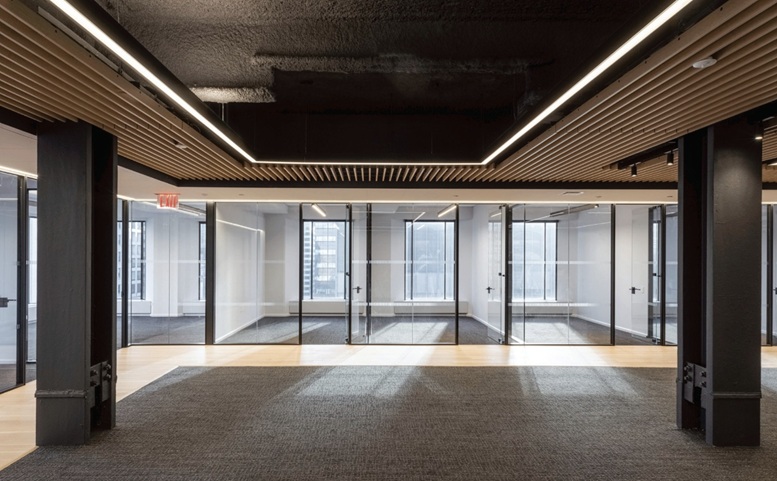
The broader Manhattan office market has strengthened significantly. According to CBRE’s second-quarter 2026 Manhattan office report, the availability rate fell to 14.4%, down 310 basis points from one year earlier.
Second-quarter leasing activity totaled approximately 7.88 million square feet, 24% above the five-year quarterly average. Year-to-date leasing reached approximately 14.89 million square feet.
Midtown showed similar momentum. CBRE reported that Midtown’s availability rate fell to 12.7%, down 280 basis points year over year. Midtown recorded approximately 1.87 million square feet of positive net absorption during the first half of 2026.
Those statistics point to a strengthening market, but they still understate what is happening at the upper end.
Newmark’s second-quarter 2026 Manhattan research found that total available space was 30.6% below its second-quarter 2023 peak. The amount of available Class A large-block space had fallen 51.4% since 2021.
For financial firms looking for premier office space, that contraction is increasingly noticeable. Instead of choosing among dozens of comparable options, firms may be competing for a limited inventory of appropriately sized, well-located and well-built spaces.
The most important statistic for many financial-services tenants is not Manhattan’s overall availability rate. It is what is happening inside the best buildings.
Newmark reported that direct availability in Midtown Trophy properties fell to just 2.7% in the second quarter of 2026. CBRE reached a similar conclusion in its analysis of prime office inventory, reporting that Midtown Manhattan’s prime vacancy rate declined to 2.2%.
Manhattan availability: 14.4%. Midtown Trophy direct availability: 2.7%.
Headline availability does not reflect the scarcity of the premier buildings and installations most sought after by financial firms.
That is a dramatically different market from the perception created by double-digit overall availability.
For tenants unfamiliar with Manhattan building categories, we previously explained the differences among Trophy, Class A, Class B and Class C office buildings in New York City.
A tenant may hear that Manhattan has “plenty of office space” while simultaneously struggling to identify several compelling options for a 7,500-, 10,000- or 15,000-square-foot hedge fund or private equity firm.
There may still be plenty of office space. There is not necessarily plenty of the office space financial firms actually want.
Financial services remains one of the largest sources of office demand in Manhattan.
According to Cushman & Wakefield’s second-quarter 2026 Manhattan MarketBeat, financial-services companies represented 37.5% of new Manhattan leases larger than 10,000 square feet during the first half of 2026. Class A properties captured approximately 82.6% of year-to-date leasing activity.
Financial firms are not simply leasing office space. They are disproportionately leasing better office space.
Hedge funds, private equity firms, investment managers and family offices typically place a premium on:
Many premier landlords have invested heavily in hospitality-style amenities to meet those expectations. We examined several examples in our look inside Midtown Manhattan’s most exclusive office buildings and their new amenities.

When many firms pursue the same combination of location, image, amenities and quality, demand becomes concentrated within a relatively small portion of Manhattan’s total inventory.
“Flight to quality” became one of commercial real estate’s most frequently used expressions after the pandemic.
Initially, it primarily described tenant preference. Today, it is increasingly becoming a supply constraint.
Companies spent several years consolidating into better buildings, upgrading their office environments and prioritizing locations capable of attracting employees back to the workplace. That strategy absorbed a significant amount of premier inventory.
Now, the remaining supply of the best spaces is becoming increasingly limited.
A recent example is the 9,421-square-foot Trophy sublease at the GM Building, 767 Fifth Avenue. It combines a premier Plaza District address, a newly built installation, immediate occupancy and best-in-class amenities—precisely the characteristics many hedge funds, family offices and investment firms are seeking.
This does not mean every Manhattan landlord suddenly has leverage. It means the divide between premier buildings and commodity office product has widened considerably.
CBRE reported an average Manhattan asking rent of $80.17 per square foot in the second quarter of 2026. That number has limited relevance to a financial firm evaluating premium space on Park Avenue, Madison Avenue or Fifth Avenue.
Two buildings located one block apart may technically both be considered Class A while experiencing dramatically different demand, occupancy, pricing and negotiating leverage.
Likewise, a space with a higher face rent can sometimes produce better overall economics.
Once construction costs, landlord contributions, free rent, furniture, relocation expenses and downtime are considered, the higher-rent option may be economically competitive—or even less expensive on an all-in basis.
Sophisticated lease analysis should therefore focus on total occupancy cost, not simply the asking rent.
Another meaningful shift has occurred within Manhattan’s sublease market.
During the early post-pandemic years, financial firms could occasionally find extraordinary furnished sublease opportunities: expensive existing buildouts offered at meaningful discounts to comparable direct space.
Much of that inventory has since been absorbed. CBRE reported a Manhattan sublease availability rate of 2.3% in the second quarter of 2026. Midtown’s sublease availability rate was also 2.3%.
High-quality furnished subleases still become available, but the best options—particularly smaller installations designed for financial firms—can move quickly.
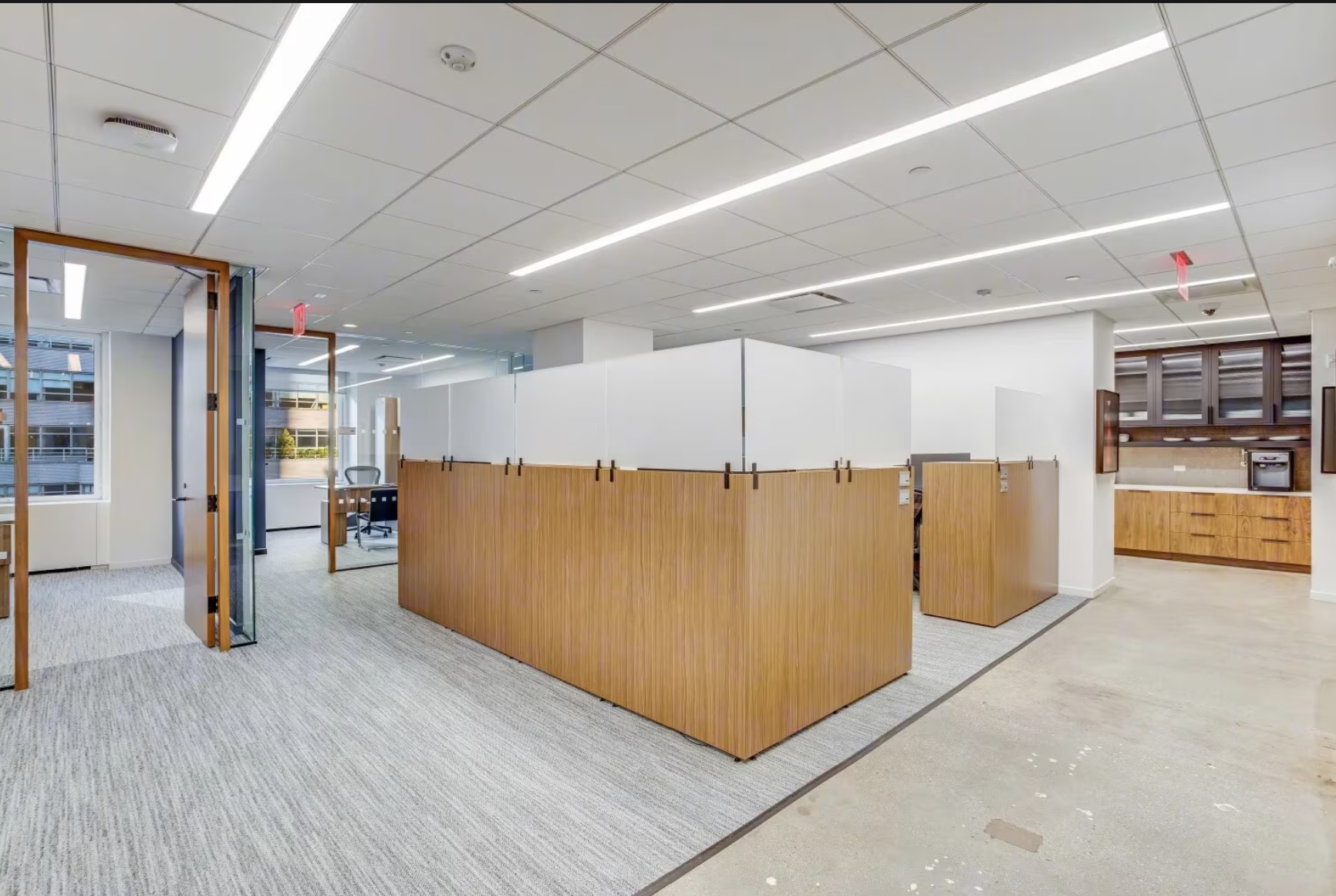
The 10,846-square-foot furnished sublease at 477 Madison Avenue is a good example. It offers an entire high-end floor with executive offices, multiple conference rooms, excellent light and furniture available.
For financial firms, spaces like this can eliminate much of the time, cost and uncertainty associated with designing and constructing a new office.
The largest transactions receive the most publicity, but some of the greatest competition is occurring within smaller blocks of premium office space.
A hedge fund, family office or emerging private equity firm may require only 5,000 to 15,000 square feet. Its needs, however, can be unusually specific:
There are only so many spaces matching that description at any given time.
A 7,500-square-foot high-end prebuilt space on Park Avenue is not necessarily competing against every 7,500-square-foot office in Manhattan. It may be competing against only a handful of legitimate alternatives.
That is why broad vacancy statistics can be particularly misleading for boutique financial firms.
Although amenities and building quality have become increasingly important, location remains a primary consideration for financial firms.
Grand Central and Midtown East continue to benefit from extraordinary transportation access, proximity to many of Manhattan’s premier residential neighborhoods and a deep concentration of financial-services companies.
For hedge funds, private equity firms and asset managers seeking boutique-sized space, the combination of location, existing installation and transportation access can substantially narrow the pool of realistic alternatives.
The supply side of the office market is also changing.
CBRE’s second-quarter 2026 U.S. office report found that the national office construction pipeline remained near a record low. At the same time, office conversions and demolitions continue to remove older inventory from the market.
Newmark estimates that approximately 18.3 million square feet of Manhattan office inventory has either entered the conversion process or is being considered for conversion, following approximately 3.9 million square feet converted since 2020.
Most conversions involve older office properties rather than Trophy buildings. Even so, the broader reduction in supply—combined with a limited pipeline of new premier construction—should continue to support the best assets.
For hedge funds, private equity firms, investment banks and asset managers, the office continues to play an important role in:
As a result, many firms are not necessarily taking more space. Instead, they are allocating more capital toward better space.
A company may reduce its footprint from 20,000 square feet to 15,000 square feet while simultaneously moving into a better building, paying a higher rent per square foot and investing more heavily in the workplace experience.
The objective is increasingly not more office. It is better office.
Waiting until a lease expiration is imminent can significantly reduce optionality. For firms with specific location, layout or building requirements, beginning the process 18 to 30 months in advance can help uncover opportunities that may never appear during a traditional six- or nine-month search.
The best space may not be publicly marketed when a tenant begins its search. Forward commitments, pending relocations, early lease negotiations, upcoming expirations and off-market subleases can create opportunities well before a space appears on traditional listing platforms.
A meaningful comparison should consider base rent, free rent, operating-expense and real-estate-tax escalations, tenant-improvement allowances, construction costs, furniture, moving expenses, technology, potential downtime and lease flexibility.
The lowest asking rent does not always produce the lowest occupancy cost.
Landlord leverage can vary enormously from one building to another. A nearly full Trophy building with several tenants pursuing the same space may have little incentive to move materially on economics. A competing building nearby may have several vacancies and considerably greater motivation to complete a transaction.
Understanding those building-level dynamics can materially affect negotiating strategy.
Perhaps the biggest mistake a tenant can make in 2026 is viewing Manhattan as a single office market. Several markets are operating simultaneously:
That divergence is likely to remain one of the defining themes of New York office leasing.
The takeaway is not simply that Manhattan office space is recovering.
It is that the supply of high-quality office space most desired by financial firms is tightening considerably faster than the broader market.
For hedge funds, private equity firms, family offices, investment managers and other financial-services companies considering a renewal or relocation, the next several years may reward firms that begin planning early, monitor both marketed and off-market opportunities and evaluate transactions based on total economic impact rather than face rent alone.
As Trophy and premium Class A inventory becomes scarcer, access to accurate building-level market intelligence—including knowing which opportunities are likely to become available before they officially reach the market—can materially improve both economics and optionality.
Spaces Commercial Real Estate represents tenants throughout Manhattan, with a particular focus on hedge funds, private equity firms, asset managers, family offices, investment banks and other financial-services companies.
Whether you are evaluating a renewal, relocation, furnished sublease or off-market opportunity, we can help compare available and upcoming options throughout Park Avenue, Madison Avenue, Fifth Avenue, the Plaza District, Grand Central, Bryant Park, Rockefeller Center, Hudson Yards and Manhattan West.
Market statistics reflect the latest cited 2026 reports available from CBRE, Newmark and Cushman & Wakefield. Availability, vacancy and asking rents change over time and may vary by building, submarket and space condition.
tags:
category:
recent posts:
BlackRock, Bank of America and Third Point had Midtown Manhattan's most notable new leases. There is no question that 2017 was a solid year for New York City commercial real…
The office space market is being dictated by ONE thing, Culture! As one of the more active office space brokers in New York City, I can’t help but cringe when…

623 Fifth Avenue: Discretion, Prestige, and a Crown-Jewel Penthouse in the Plaza District In the Plaza District, an address alone is no longer enough. Today’s hedge funds, private equity firms,…

Hedge Fund Spaces | Park Avenue | New York, NY 10022
 CATEGORIES
Copyright © 2025, HedgeFundSpaces.com. All Rights Reserved.
These advertisements do not suggest that the broker has a listing or has done a transaction in this property or properties.


 CONTACT
 about us
 516-557-1160
 Find your space